
Uganda is often regarded as one of the most attractive countries in Africa for birdwatchers, not only due to the impressive number of bird species found within its borders but also because Birding Safaris Uganda provides easy access to numerous bird-rich habitats that are hard to reach in other parts of the region. Uganda’s remarkable avian diversity—1,008 recorded species in an area comparable to that of Great Britain—can be attributed to its location at a transitional point between the East African savanna, the West African rainforest, and the semi-deserts of the north.
The key to Uganda’s diverse ecosystems lies in its variety of habitats: arid semi-desert, rich savannahs, lowland and montane rainforests, extensive wetlands, volcanic areas, and an Afro-alpine zone. The country’s altitude ranges from 650 to 5,000 meters.
Interestingly, only one bird species is endemic to Uganda: the rather ordinary Fox’s weaver. However, if we consider only the East African region, approximately 150 bird species—over 10% of the regional checklists—are found exclusively in Uganda. The Uganda Birding Safaris list includes seven of the 20 hornbill species recorded in the region, five out of 14 honeyguides, and several others, such as 13 species of thrush, 11 warblers, 10 flycatchers, eight sunbirds, eight weavers, eight finches, four tinkerbirds, four pigeons, three kingfishers, three sparrowhawks, three cuckoos, and three nightjars.
Many of these unique Ugandan species are West African and Congolese forest birds that can be challenging to see elsewhere due to the lack of tourism development in the other countries where they are found. The rainforests of Western Uganda are considered the most important bird habitat in the country, particularly appealing to birdwatchers who are already familiar with typical East African birds. Some of the most captivating forests in Uganda that are home to localized species include Semliki, Budongo Forest, Kibale Forest, and Bwindi Forest. Kibale, in particular, is renowned for its forest birds, as well as the nearby Magombe swamp. Even the relatively tame botanical gardens in Entebbe can yield several interesting bird sightings.
If you’re eager to see a wide range of birds in Uganda for your birdwatching tour, consider visiting locations such as Entebbe (for water and forest birds), Lake Mburo (for water and acacia-associated birds), Queen Elizabeth National Park (where over 600 species are recorded), Murchison Falls (the best place in East Africa to see the papyrus-associated Shoebill), and Kidepo Valley National Park (which has recorded over 50 raptor species).
List of Some Bird Species in Uganda
- The ostrich is the world’s largest bird, exclusively in Kidepo Valley National Park.
- Pelicans: Water birds commonly seen in the Kazinga Channel in Queen Elizabeth National Park.
- African Darter: Known as a snake bird, the African darter has an elongated rufous neck that extends serpentinely.
- Goliath Heron: Frequently observed during boat trips in Murchison Falls National Park.
- Hamerkop: A medium-sized waterbird seen on the Mweya Peninsula in Queen Elizabeth National Park.
- Saddle-billed Stork: The largest and most striking of several stork species, usually seen in pairs during game drives in Murchison Falls.
- Marabou Stork: A scavenging stork common in both rural and urban environments, particularly in downtown Kampala.
- Shoebill: An unmistakable large grey swamp dweller, this bird is a major attraction for many ornithological tours to Uganda. They are primarily found in Semliki Wildlife Reserve, Mabamba Swamp, and Murchison Falls.
- Flamingos: Sociable pink-white algae eaters often seen in large concentrations at Katwe and Flamingo Crater Lakes in Queen Elizabeth National Park.
- African Fish Eagle: A unique raptor known for its fish-eating habits.
- Helmeted Guinea Fowl.
- African Jacana: Commonly found in most wetlands across Uganda.
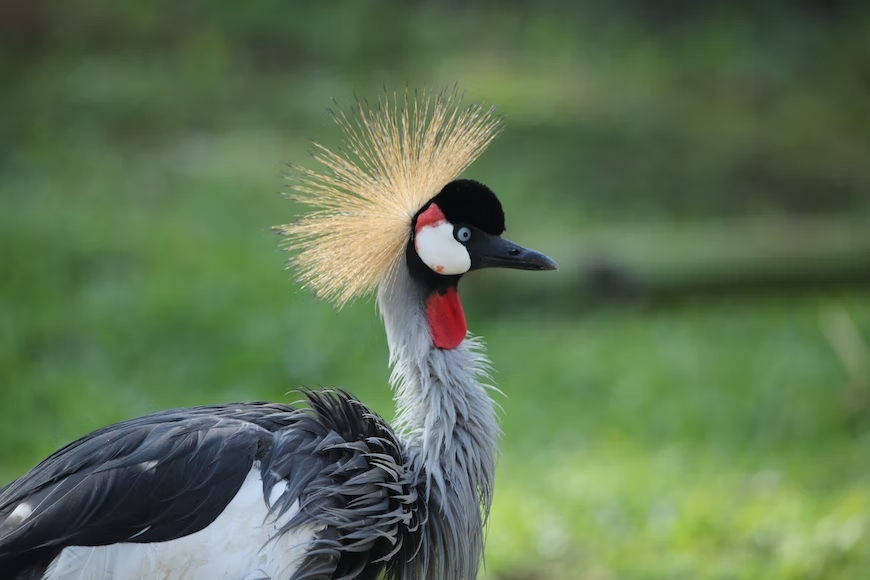
- Grey-crowned Crane: Uganda’s national bird, often found in swamps and grasslands.
- African Grey Parrots: Typically seen in forested habitats.
- Great Blue Turaco: Found in forested areas, including Entebbe Botanical Gardens.
- Ross’s Turaco.
- Eastern Grey Plantain-Eater.
- African Emerald Cuckoo.
- Coucals.
- Verreaux’s Eagle Owl: The largest owl species in Uganda, mostly seen during night drives.
- Pennant/Standard-Winged Nightjars: Often spotted on the road to the top of Murchison Falls after dusk.
- Pied Kingfisher.
- Giant Kingfisher.
- Malachite Kingfisher.
- Red-Throated Bee-Eater: Breeds in tall sandbanks along Lake Albert and the Nile below Murchison Falls.
- Lilac-Breasted Roller.
- Hoopoe.
- Black and White Casqued Hornbill.
- Fork-Tailed Drongo.
- Piacpiac: Commonly found in Jinja and Murchison Falls.
- African Finfoot.
- Jackson’s Francolin.
- Denham’s Bustard.
- African Skimmer.
- Blue-Throated Roller.
- Black Bee-Eater.
- Forest/White-Headed Wood Hoopoe.
- African Pied Hornbill.
- Chocolate-Backed Kingfisher.
- Papyrus Gonolek.
This revised list should provide clearer information on the various bird species found in Uganda.
Birding in Queen Elizabeth National Park
Queen Elizabeth National Park is classified as an Important Birding Area (IBA) by Birding International. The park’s diverse habitats are home to over 600 bird species, which is the highest number found in any East African national park and remarkable for such a small area. The park’s combination of savanna and forest ecosystems, linked to the expansive forests of the Democratic Republic of Congo, allows visitors to spot both East and Central African bird species.
The park hosts numerous water birds, woodland and forest dwellers in the Maramagambo Forest, 54 species of raptors, and various migratory species. Key bird species include the Martial Eagle, Black-rumped Buttonquail, African Skimmer, Chapin’s Flycatcher, Pink-backed Pelican, African Broadbill, Verreaux’s Eagle Owl, Black Bee-eater, White-tailed Lark, White-winged Warbler, Papyrus Gonolek, Papyrus Canary, Corncrake, Lesser and Greater Flamingo, Shoebill, and Bar-tailed Godwit.
For the best birding experiences in Queen Elizabeth National Park, don’t miss the following hotspots: Kazinga Channel, Kasenyi Area, Mweya Peninsula, Maramagambo Forest, Ishasha Sector, Lake Kikorongo, Katunguru Bridge area, and Katwe Area. Tours can be booked through the Katwe Tourism Information Center.
Birding in Murchison Falls National Park
Murchison Falls National Park offers both game drives and boat trips that provide opportunities to encounter unique birdlife, including savannah forest birds, water birds, and Albertine Rift endemics. The park’s main attraction for birding is the Shoebill, which is best sighted during the dry season from January to March. Common species found in the plains include the Marabou Stork, Abyssinian Ground Hornbill, Secretary Birds, Black-bellied Bustards, Open-billed Storks, and Widow Birds.
Closer to the river, where thickets and woodlands are more prevalent, you can find the Swallow-tailed and Red-throated Bee-eaters, particularly around the Nyamusika Cliffs, as well as Woodland, Pied, Giant, and Malachite Kingfishers, Francolin, Hornbills, Grey Herons, Hamerkop, Shrikes, Flycatchers, Cuckoos, Woodpeckers, Crombecs, and Warblers. The riverbanks also host ducks, geese, stilts, and plovers.
Birding in Bwindi Impenetrable National Park
Bwindi Impenetrable National Park, Uganda’s oldest forest, features a diverse habitat that supports a wide variety of birds, with 350 species recorded, including 23 endemics (90% of all Albertine Rift endemics) such as the Short-tailed Warbler and Blue-headed Sunbird, along with seven IUCN Red List species. Common sightings include the African Emerald Cuckoo, Common Bulbul, African Blue, White-tailed Blue Flycatchers, and Red-headed Bluebill.
Birding opportunities are available along the main trail, the Buhoma Waterfall Trail, and in the bamboo zone and Mubwindi Swamp Trail in Ruhija.
Birding in Semuliki National Park
Birders visiting Semuliki National Park will be rewarded with some of Africa’s finest forest birding. The Sempaya and Ntandi areas offer excellent bird-watching opportunities, where you can spot the White-crested Hornbill, Red-billed Dwarf Hornbill, Piping Hornbill, Yellow-throated Nicator, and the Great Blue and Ross’s Turacos. The area around the Kirumia River is another top birding spot. The Shoebill Stork is regularly seen at close quarters on Lake Albert, and forest walks provide good chances to track water birds.
Birding in Mount Elgon National Park
Mount Elgon National Park offers excellent birding opportunities, particularly around the Kapkwai Forest Exploration Centre. The secondary forest and dense shrubs along the loop trails leading to Cheptui Falls are great spots for birdwatching. Notable species include the African Goshawk, Chubb’s Cisticola, White-chinned Prinia, African Blue Flycatcher, Chinspot Batis, Mackinnon’s Fiscal, Doherty’s and Luhders Bush-shrikes, Baglafecht Weaver, Cinnamon Bee-eater, Moustached Tinkerbird, Hartlaub’s Turaco, Tacazze Sunbird, Olive- and Bronze-naped Pigeons, Black Kite, and Black-collared Apalis.
Birding in Lake Mburo National Park
Key birding locations in Lake Mburo National Park include swampy valleys and viewing platforms near the salt licks and within the forest. Species found in these areas include the Rufous-bellied Heron, Bateleur, Coqui Francolin, Grey Crowned Crane, Black-bellied Bustard, and Brown-chested Lapwing.
The best birding spots in Lake Mburo include the swampy valleys of Warukiri and Miriti, as well as the roadsides between Rwonyo camp and the jetty. There are also well-placed viewing platforms at the salt lick, in Miriti Valley, and in Rubanga Forest. Birds observed in these areas include the Rufous-bellied Heron, Bateleur, Coqui Francolin, Grey Crowned Crane, Black-bellied Bustard, Brown-chested Lapwing, Emerald-spotted Wood-Dove, Brown Parrot, Red-headed Lovebird, Ross’s Turaco, Bare-faced Go-away-bird, Green Wood-hoopoe, Common Scimitarbill, White-headed Barbet, Red-faced Barbet, Nubian Woodpecker, Red-shouldered Cuckoo-shrike, Long-tailed Cisticola, Yellow-breasted Apalis, White-winged Tit, and Finfoot, among others.
Rubanga Forest can be accessed by vehicle or on foot, making it an attractive spot for keen birders. It is advisable to arrange visits in advance with the warden. One of the forest’s highlighted species is the rare Red-faced Barbet, which is exclusively found in Lake Mburo National Park.
Birding in Mgahinga Gorilla National Park
Birding in Mgahinga also showcases some of the park’s most stunning landscapes. The gorge between Mounts Gahinga and Sabinyo, the bamboo forest, and the montane forest provide great opportunities to observe the beautiful Rwenzori Turaco.
The three to four-hour Gorge Trail between Gahinga and Sabinyo presents chances to see the Dusky Turtle Dove, Cape Robin-chat, Kivu Ground Thrush, Olive Thrush, Brown-crowned Tchagra, Bronze Sunbird, Regal Sunbird, Blue-headed Sunbird, Rwenzori Batis, Black-headed Waxbill, and Streaky Seedeater.
Other excellent birding areas include the bamboo belt at approximately 2,500 meters above sea level and the tall montane forest at 2,660 meters. The Rwenzori Turaco is often sighted around 2,700 meters. Along the Uganda-Congo border and on level ground, vocal yet inconspicuous species like Chubb’s Cisticola, Red-faced Woodland Warbler, Banded Prinia, and Doherty’s Bush-shrike inhabit the dense vegetation at the forest’s edge.
Birding in Kibale Forest National Park
Bird-watching tours in Kibale Forest National Park begin at 7 am at Kanyanchu. The nearby Bigodi Wetland Sanctuary is home to 138 bird species, which can be seen during guided walks along the boardwalk trail and at viewing platforms. It is recommended to book in advance. Rare species include the Papyrus Gonolek, White-winged Warbler, White-collared Oliveback, and Papyrus Canary.
Bigodi Wetland Sanctuary is notable for its diverse birdlife, which includes the White-spotted Flufftail, Yellow-spotted Barbet, Hairy-breasted Barbet, Yellow-billed Barbet, Western Nicator, Grey-winged Robin-chat, White-tailed Ant-thrush, Brown-backed Scrub-robin, Black-and-white Shrike-flycatcher, Brown-throated Wattle-eye, Superb Sunbird, Brown-crowned Tchagra, Bocage’s Bush-shrike, Black Bishop, White-breasted Negrofinch, and Black-crowned Waxbill, among others.
Birding in Rwenzori Mountains National Park
In Rwenzori Mountains National Park, bird watching is most fruitful in the montane forest. The park is home to 217 species, including bee-eaters, robins, sunbirds, and barbets.
Given the challenging environment of the high Rwenzori, few species choose to inhabit this region. Notable birds include the Rwenzori Turaco and Long-eared Owl; at higher elevations, you may spot Bearded Vultures, Swifts, and Black Eagles in search of prey.
Birding in Kidepo Valley National Park
Apoka Rest Camp is an excellent starting point for your birding adventure in Kidepo Valley National Park. Birdwatching can also be enjoyed around the edges of the Narus and Namamukweny Valleys.
At Apoka Rest Camp, you can expect to see a variety of birds, including the Abyssinian Roller, Purple Heron, Abyssinian Ground Hornbill, and Clapperton’s Francolin, which is unique to Kidepo. Birding activities can be arranged both in the morning and evening.
Birding in Mabamba Swamp
Mabamba Swamp is located on the outskirts of Lake Victoria in western Uganda. The Shoebill, a rare and fascinating bird, can be found in only four countries—Uganda, Rwanda, South Sudan, and Zambia—with Mabamba Swamp being the best location to spot it. You can access the Mabamba wetland from either Kampala by car or Entebbe by boat. The drive from Entebbe or Kampala to Mabamba takes about one hour, depending on how many stops you make for birdwatching. It’s advisable to leave your hotel early to avoid traffic and the heat of the day, which can reduce bird activity. Upon arriving at the swamp via boat from Entebbe, you will transfer to a canoe to reach the shoebill’s habitat.
For seasoned birders, there are many other bird species to discover in the community and the swamp. Numerous water birds, including migratory species from Europe, can be seen. In addition to the Shoebill, look out for bird species such as the Angola Swallow, Swamp Flycatcher, Olive-bellied Sunbird, Grey-rumped Swallow, Blue-breasted Bee-eater, African Jacana, African Fish Eagle, Long-tailed Cormorant, Yellow-billed Duck, Malachite Kingfisher, Glossy Ibis, White-winged Tern, Hamerkop, White-faced Whistling-Duck, Spur-winged Goose, Knob-billed Duck, Little Stint, Great Cormorant, Grey-headed Gull, Spur-winged Lapwing, Black-winged Stilt, Madagascar Bee-eater, Yellow-rumped Tinkerbird, Sooty Chat, Weyns’s Weaver, Grosbeak Weaver, Crowned Hornbill, African Pied, Common Squacco Heron, Red-billed Fire Finch, and more.